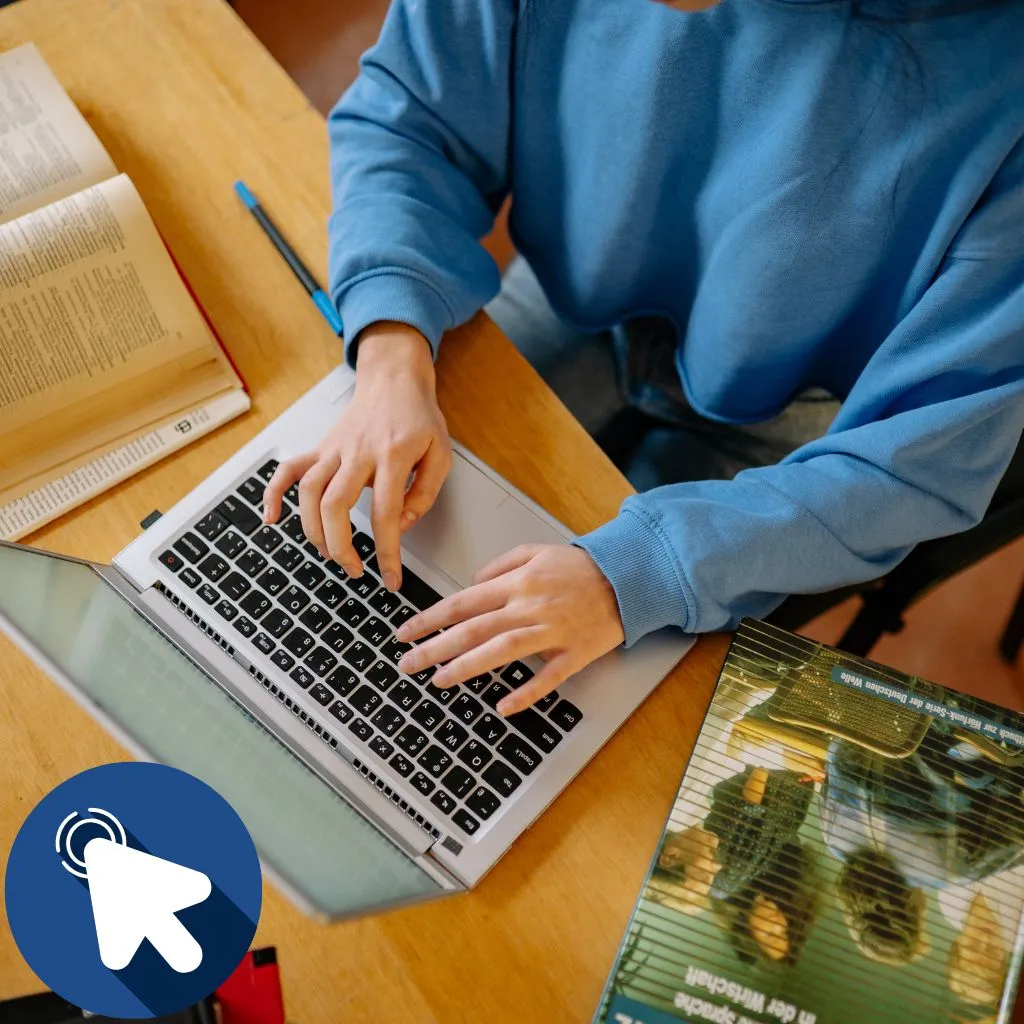

In youth work, we often talk about inclusion, but when it comes to digital environments, our understanding of who we are including is not always as clear as we think.
When you hear the word disability, what comes to mind?
For many, it’s still something visible or clearly defined. But in digital youth work, the reality is much broader and much more relevant to your daily practice than it might seem.
Beyond labels: thinking in terms of abilities
In online environments, young people interact in very different ways.
- Some rely on visual content, others on audio
- Some need more time to process information.
- Some use assistive technologies.
- Some struggle with focus, anxiety, or information overload.
This means that what we often call “disability” is actually part of a wider diversity of abilities.
And here’s the key point: digital youth work is not about designing for “the average participant”, because that participant doesn’t really exist.
Instead, it’s about recognising variation and responding to it.
A Shift that changes everything
A useful way to understand this is through two perspectives:
- The medical model focuses on the individual – what they “can’t do.”
- The social model focuses on the environment – what is not accessible.
In youth work, this shift is powerful. The social model highlights that people are often “disabled” not by their condition, but by barriers created by society, systems, and design .
In digital settings, this becomes even more visible. If a young person cannot engage with your online activity, is it because of their ability or because the format wasn’t flexible enough?
This question alone can transform how you approach planning and facilitation.
Not all barriers are obvious
One of the biggest challenges in digital youth work is that many barriers are invisible.
You might not immediately notice:
- a participant struggling with reading-heavy content
- someone overwhelmed by fast-paced interaction
- a young person avoiding participation due to anxiety
- someone dealing with poor connectivity or limited devices
Digitalisation has created new opportunities, but also new forms of exclusion. Not all young people experience digital spaces equally, and without intentional design, these spaces can easily reinforce inequality .
Why this matters for your practice
Understanding disability as diversity is not just a theoretical idea and it directly affects how you work.
It influences:
- how you design activities
- how you communicate instructions
- how you choose tools and platforms
- how you interpret participation (or lack of it)
For example, if participation is only possible through speaking, typing fast, or reacting quickly, you are already limiting who can engage.
But if you offer multiple ways to participate (such as chat, voice, visuals, time to reflect) you open the space for more young people.
From inclusion to intentional design
Digital youth work is not just about being present online and it’s about creating intentional, inclusive digital environments that respond to young people’s real experiences .
This means:
- anticipating different needs, not reacting only when issues appear
- designing with flexibility from the start
- involving young people in shaping the experience
- being ready to adapt, reflect, and improve
Inclusion doesn’t happen automatically and it needs to be built into the process.
A small reflection for your next activity
Before your next online session, pause for a moment and consider:
- Am I assuming one “normal” way of participation?
- Who might find this difficult and why?
- What small adjustment could make this more accessible?
You don’t need to redesign everything. But even one change such as simplifying instructions, adding visual support, allowing more time, can make a meaningful difference.
Want to explore this topic further and learn practical skills? Discover the free SEOywd online course designed to support youth workers and educators in building inclusive and accessible digital experiences.